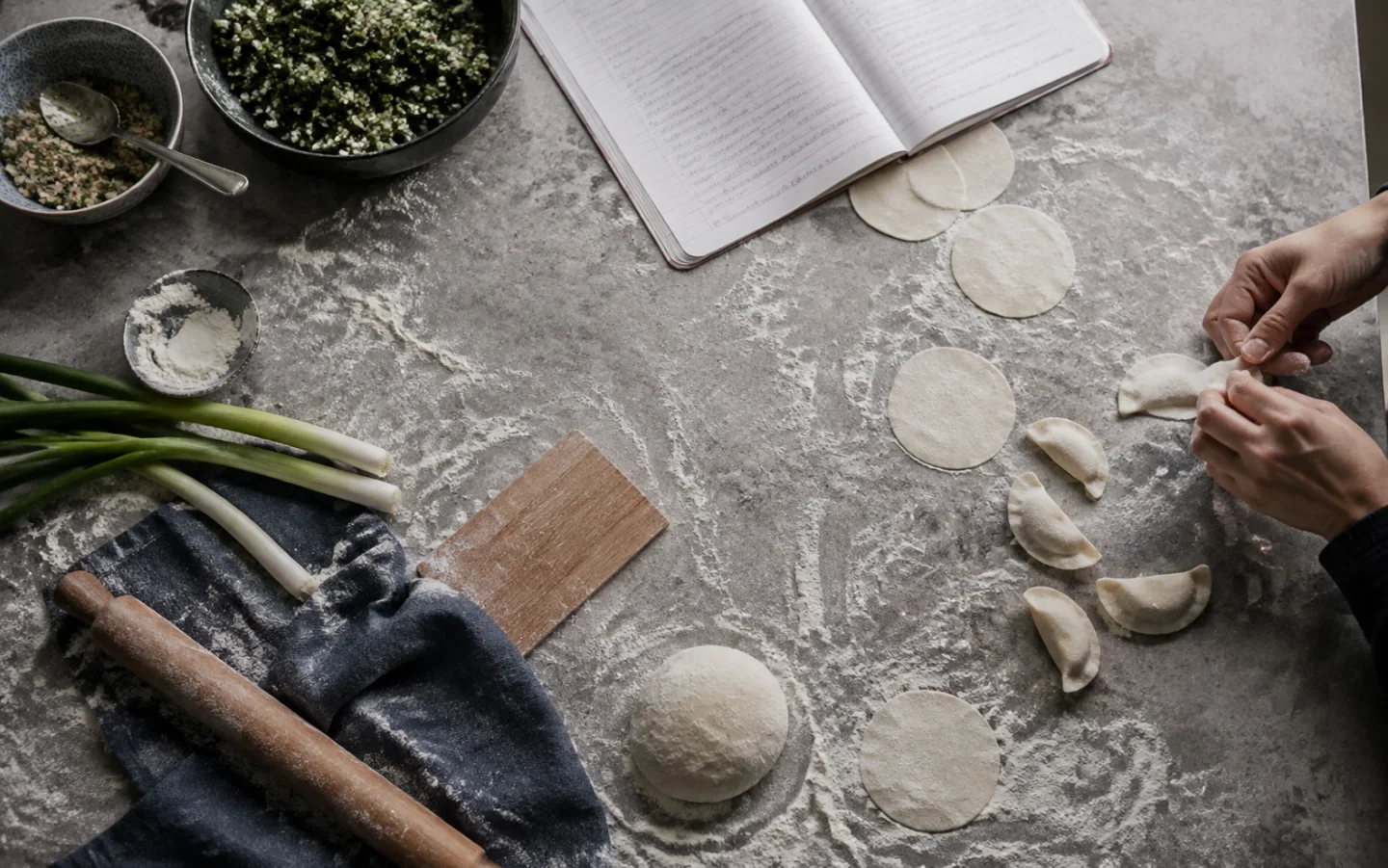
Old recipe books can be frustratingly vague. A spoonful, enough flour, cook until ready. Their imprecision points to knowledge that was once learned by watching.
Method note: This essay treats family recipes as living knowledge. It does not assign cultural ownership or authenticity without evidence from the people concerned.
The missing instructions
A family recipe often records ingredients while assuming the cook already knows the motions. It may not explain how the dough should resist a fingertip or how the filling changes when the salt has rested. The page is a reminder, not a complete manual.
This is why the first attempt can taste close but not quite right. The missing information is physical. It lives in pressure, timing, sound and the confidence to stop before the food looks finished.
Learn beside someone
Cooking together reveals the quiet decisions that rarely reach the notebook. A more experienced cook adjusts water after touching the flour, lowers the heat after hearing the pan and rejects a neat fold because it trapped too much air.
Asking why can help, but imitation matters too. Hands remember a movement before language finds a precise way to describe it. Repetition turns a mysterious gesture into an ordinary one.
Write the version you made
Preserving a recipe does not mean freezing it. Record what happened in your kitchen: the size of your spoon, the pan you used, the point when the dough felt ready and what you would change next time.
Over years, the notes become a conversation between cooks. The recipe stays alive because each person adds enough detail for the next attempt, while leaving room for judgment to grow.
Document context, not only ingredients
UNESCO describes foodways as living heritage connected with community identity. From that perspective, a recipe is more than a formula. The occasion, tools, gestures, substitutions and people who teach it can be as important as the ingredient list.
When recording a dish, ask who usually made it, when it appeared and what counted as a successful result. Note whether an ingredient changed after migration or because of cost. These details prevent the written version from pretending there was only one fixed and universally correct form.
Run a useful kitchen interview
Set up a phone to record audio only after everyone agrees. Ask the cook to describe what they are checking at each stage. Questions such as what would make you add more water or how do you know the heat is too high reveal decisions that a list of measurements misses.
Photograph hands, tool positions and ingredient texture rather than asking someone to stop and pose. Afterward, return the draft to the cook. They may correct an assumption, add a memory or ask that a private family detail remain unpublished.
Write for the next attempt
Record weights where they help, but also describe sensory checkpoints. Dough may feel smooth yet slightly resistant; onions may become sweet before they brown. Include pan size and heat source because those details can change timing more than an extra gram of spice.
Date each revision and keep the previous one. A change is not a failure of preservation. It is evidence that the recipe remains in use. The archive becomes stronger when it shows both continuity and adaptation.